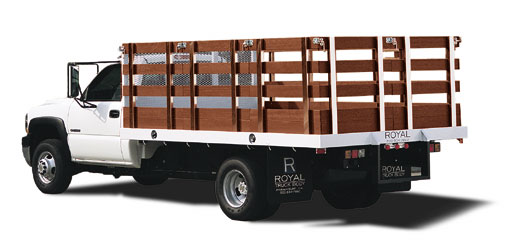
Stake-Bed Flatbed trucks are available for rental for about $180 a day plus taxes and fees.
The sides can be removed with two people. Gloves are a good idea, to avoid splinters.
They come in several lenghts, the shorter ones are cheaper and easier to drive but don’t fit as many people.
Many have ‘lift gates’ a small elevator on the back that can make it accessible to those who cannot climb.
⚠ Lift gates are very prone to injuring folks, be very careful operating it. The edge closer tot the truck is a pinch point
Here is a short video on use.
You do not need a special Driver’s Licence, though It is a very good idea to have a designated driver with large-vehicle experience and one or two co-pilots with walkie talkies for manevering thru crowds in a noisy environment.
Sound Truck Quick Guide: Marches
A sound truck at a slow march has different dynamics than normal driving. Speedometers don't register at 2 mph, the truck must pace to the slowest participant, and there are usually people in the bed with the equipment. Clear roles and clear comms are necessary to keep it safe. Without coordination people can get really hurt.
The non-negotiable safety rules
- No one on or off while the truck is moving. Request a stop, wait until the truck comes to a full stop, then get on or off.
- Driver or co-pilot confirms folks in truck bed are ready before every truck move. Give folks time to hold on or, ideally, sit.
- Limit passengers in the bed. A pickup with equipment usually has room only for one or two chant leads and a sound operator. Flatbeds can fit more, but set expectations of limit before the day so folks can plan. Flat beds, must have side rails.
- Equipment (speakers etc) should be firmly secured - and be able to withstand significant bumps, turns, g-forces etc. Ideally equipment is bolted and/or ratchet-strapped to the truck. Tripod speaker stands (even with standbags) can be dangerously insecure - and portable scaffolding/truss totems are stronger and easier to secure. Bungee cords and tape are useless here, use ratchet straps to hard points and test each speaker by pressing 30lbs of force in all 4 directions to ensure it will be stable throughout march. If truck has wooden bed, using structural screws thru drilled holes in tripod legs can be very effective. A falling speaker coudl kill or disable a person easily, it is crucial they be well-secured.
- Do not use the speaker stands as handrails, they are not strong enough and could bend or snap and cause serious injury
Ideals:
- No children in the bed of the truck
- One voice to the driver. Except emergency stops, driver is taking direction from at most 2 designated folks - the Copilot in the truck and the Truck Lead outside of the truck. Random folks often bark commands at driver and it is super confusing and can actually lead to dangerous situations. Clarify truck control before rollout.
- Pace = slowest participant. Follow the pacer
Truck safety:
The very slow moving truck leads to both march participants and enthusiastic bystanders to thinking they can safely walk right in front of the truck. An additional person in front of the truck with the Truck lead can be very useful for keeping the path in front of the truck clear. Flatbeds: The high clearance of flatbed trucks creates additional dangers of marchers wanting to walk close to it and at risk of being caught on something or getting hit by rear wheels. A person walking midway on each side of a truck to keep people away is a useful safety precaution.
Possible roles- Suggestions for ease and safety
Driver: Drives smoothly - slow start, slow stop, no lurches unless emergency. People in the bed may be standing!
Pacer: Walks slowly next to the truck. Sole job: match the slowest participant. Speedometers don't work at 2 mph, so the truck literally paces to this person's feet, can do double duty as another role, such as security person, but needs to be walking in view whenever truck is moving. We have had success conscripting a participant into this role day-of.
Truck Lead: Walks in front of truck in view of the driver. Determines if intersections are safe to enter and watches for other issues in front and around the truck (e.g., participants or bystanders who may be getting in the path of the truck). One of the two people who can direct the driver to stop or start (in addition to the Copilot/Comms coord). Also monitoring radio. In a large march, the Truck Lead is ideally paired with someone monitoring Signal. Should be integrated in the safety and program leadership of the action.
Will lead the truck in case of a need for route change during the march.
Copilot / Communication coordinator: Sits shotgun and in all the signal chats and has a radio (walkie-talkie) if they are in use. If there are multiple radio channels in use, they have two radios. They focus on information so the driver can focus on driving. Listen for reports that the march is developing gaps and direct the driver to slow down or pause at the next intersection to allow the march to mass up and close the gap.
If Copilot is also "Communication coordinator", they may repeat texts on radio and repeat radio messages over text, and encourage good radio use by shutting down chatter and ensuring messages get to intended recipient. This role makes a huge difference to security, medics, traffic, and coordinator roles.
Bed Lead: One person in the truck bed with a walkie tied to the Co-pilot (or Driver) . Handles start/stop comms from inside the bed (someone needs on/off, etc.). For pickup trucks or smaller actions, this will often be the sound person.
Sound Lead: The media setup in the truck bed needs babysitting - feedback needs to be squelched, levels need to be adjusted for different speakers. It's helpful to have someone sitting in the bed to do that and to explain mic use to each person.
Role Reduction Recommendations
Depending on the number of DSC members at an action, you may want or need to combine roles. It's important to note that this entire document is suggestive and you should do what makes sense for the action you helping carry out. That said, here are some ideas for how to cut down on staff.
Recruit Pacer from participants / event staff: The Pacer is the role that requires the least experience - you're just walking at a speed! This can be done by anyone who's attentive and enthusiastic for the role.
Combine Truck Lead and Pacer
Combine Bed Lead with Sound Person: Sound person is already are in the area and watching who is in the truck. They also don't have a lot to do when the truck is in motion.
Comms setup
- A dedicated walkie pair (different channel than other users) between Bed Lead and driver team (driver if no copilot) the speaker system makes it impossible to just speak
- Truck team Group chat for non-urgent logistics only. (speed up, slow down, gaps, hazards) Never for stop/go calls.
- Hard slap on car or roof for emergency stop - note this can cause injuries if stop is sudden and folks are standing. Use only where stopping fast would prevent an injury!
- when driver team gets word to start moving Copilot walkies the bed "truck ready to roll, is everyone in the bed ready?" Do not move without confirmation. If no reply after a few tries, get out and investigate walkie issue.
- when everyone in the bed is ready to go, Bed Lead radios to driver team "truck bed ready"
Reasons the truck stops or slows
- Emergency- Shout stop or slap cab roof- someone fell off, Use only where stopping fast would prevent an injury!
- Obstacle in the street
- Gap in the march behind truck: gaps are dangerous and leave folks behind. Cars will try to speed thru gaps, police can use gaps to split an action, and it is unkind to elders and disabled participants to leave them behind. In this case, it is ideal for truck to proceed to the upcoming intersection, then stop just before entering the intersection to reduce burden on traffic team (one less intersection to cover)
- Need from the truck bed - people on or off, a need to adjust banner or equipment, etc
Pre-roll checklist
- Roles all identified by name and visible to each other.
- Driver, Pilot, Bed Lead, and Truck Lead meet to identify each other and confirm signalling protocols. Make sure that all other staff in the front of the march know to communicate requests to stop to the Truck Lead. Make sure that Safety and Program leads communicate any truck start/stop/speed or route change needs through the Truck Lead
- Folks in the bed know the rules about capacity max, how to emergency stop, that sudden stops may occur, hold on, no on/off while moving, listen for bed lead's start/stop calls.
- Walkie channels confirmed and tested
Also, many people are used to saying “no” to the insurance for car rentals because of credit card coverage or personal car insuance plans. Note that these do not cover truck rentals and the insurance is probably a good idea. Can be as much as $60 extra per day.
Do not tell the vendors that you will be using it in a march or parade context, they will not rent to you if it breaks their policy.
Bay Area Options include: (Prices from 2021)
- SF- Coast Truck Rentals $96 per day! Small business. +1 415 282 6200
- Doherty’s Truck Rental in El Cerrito
- Penske Rentals ~$150/day San Leandro Open 7 days, much cheaper for weekend actions 510-562-1550 Many places are closed on the weekends, so they charge you for those days too.
- United Rentals $240/day has weekend deal, same as one day if taken fri pm and returned monday AM. Will price match, is negotiable
-
Enterprise Truck Rental (Not the same as car rental, be sure to call truck place) $80-150/day depending on season. sometimes 40 cents a mile, sometimes 150 free miles. Insurancew is $57/day extra, not open on Sundays. Does not price match. SF and San Leandro
-
Herc Rentals ~$250-350/day
-
SunState Rentals $425/day Oakland (510) 924-4670 is negotiable